Unlike nowadays, travel in the late 1800s was expensive, and journeys to places we think of as short and close to us took a long time. The tourists in those times were the wealthy educated explorers from the most highly advanced countries, namely the United Kingdom. They travelled to exotic places that few people in thse days had the chance to visit. Many of these early tourists published detailed accounts of what they saw and did in their journeys, which were rarely called holidays - these people were traveling for long periods of time and they saw these journeys as an occupation. Colonisation had stopped by then - what was there to be taken had already been taken - so they traveled with the scope of studying the archaeology of an area and trading with the locals, among other acitivities.
James Theodore Bent was one of those early tourists. He spent a long time touring the Cycladic islands, after which he wrote the book:
The Cyclades; or, Life among the insular Greeks, which was published in 1885. One of the islands he visited was Santorini: he always referred to it as 'Santorin'. As I read through his descriptions of Santorini, I was surprised to see how much they resemble closely how today's world views the island. Having spent a few days in Santorini recently, I decided to use Bent's account of the island to describe my own experiences. The blue wording below is taken directly from Bent's writings. I have added my own photos, with black italicised captions. Quotes from other authors are also italicised with quote marks, to distinguish them from Bent's writings.
Sit back and enjoy the trip!
CHAPTER VI: SANTORIN (THERA)
Before landing on Santorin and mixing ourselves with its people, we must consider for a brief space the particular feature of the island, namely, the volcano. The Hephaestus as they call it, has made of Santorin one of the most terrible spots in the world, and has had a powerful influence on the inhabitants.
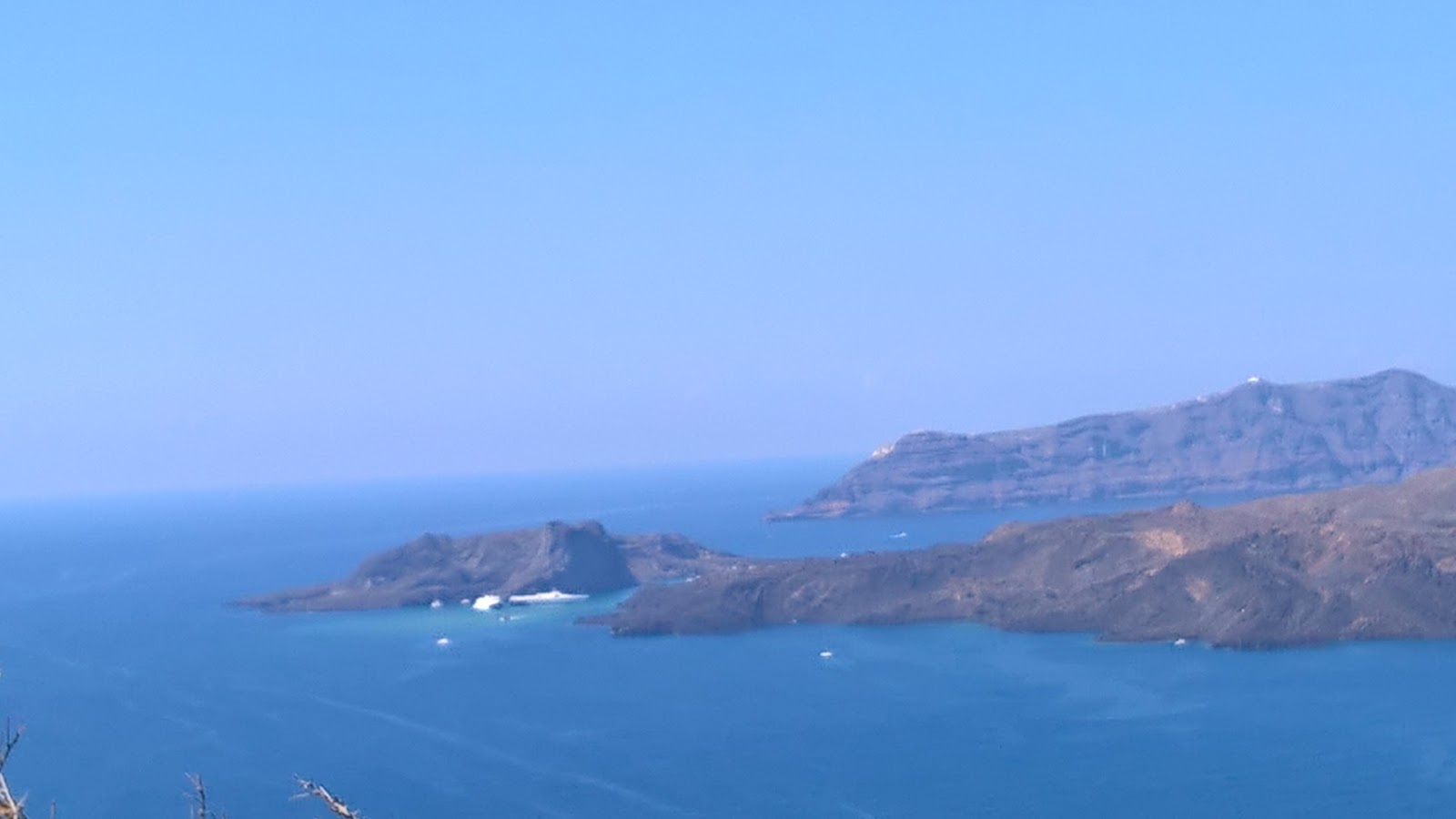
The volcano island (Nea Kammeni), as viewed from the road approaching Finikia
... The island of Santorin proper is on the outer circle, eighteen miles from point to point, and twelve on the inner circle, and it is somewhat like a horseshoe; the remainder of the circle is made up by two islands, Therasia and Aspronisi, and three channels, by which the central basin or harbour is entered.
Aspronisi (= 'white island') is the large white land mass, as viewed from the ferry boat as we approached Santorini
... The depth of the water in this central basin is immense; the cliffs go down straight into it, so that there is no possible anchorage, and vessels have to be tethered, so to speak, to the shore.
Ferry boats dock in a different port from yachts and cruise ships which cannot dock near the land. Passengers must be taken to shore via smaller boats.
:max_bytes(150000):strip_icc()/santorini-map-1500-56b2976f3df78cdfa0040338.png) |
Santorini's extremities:
Oia is located on the top left-hand
side of the 'horseshoe' while Akrotiri
is on the bottom left hand side.
The volcano in the middle,
Thirassia east of Oia, and the
tiny white rock called Aspronisi
are also part of Santorini |
... the widest part of the island is scarcely three miles, the narrowest considerably under a mile at each end of the horseshoe of Santorin are the cliffs of Akroteri and Epanomeri. Epanomeri (= 'upper place') is now called Oia. Bent never calls it Oia - he uses only Epanomeri. Here is an expanation as to how it got its newer name:
"It is paradoxical that few know that the well-known name Oia no longer has any relation to that particular region. This name was obtained by King Otto's Decree, which was published in the Official Gazette on January 11, 1834, apparently in the spirit of certain scholars. Until then, from the documents and maps, we know that it was called Eponomeria (upper places) or the Castle of Agios Nikolaos, and its inhabitants were Epanomerites. Ancient Oia, which is placed by historians at the edge of the present settlement of Kamari, had no connection with the present region ... If Oia has to justify its present name, this could be constituted by the Homeric Oia which means "distant", and in this sense indeed Oia is the most distant point of Santorini..." https://www.ayiaekaterinaoias.gr/santorini/oia.html
There is only another feature which has to be considered at the south-east corner of the island of Santorin. There rises a mountain, Mesa Bouno by name, about 1,500 feet above the sea. This mountain and its spurs are not of the volcanic formation of the rest of the island, but consist of a rock formation common to most of the Cyclades. It is evident that this Mesa Bouno was an island, around which the crater has shed its shower of pumice.
Mesa Vouno, as viewed from Perissa (we stayed in this area).
... The soil is very light and thin, consisting chiefly of crumbled pumice: it seems favourable for the growth of nothing save the grape; in fact, the slopes of Santorin form one vast vine-yard. The roads are horribly disagreeable to walk on, being like the sand on the shore which the tide does not regularly reach.
Santorini soil is very good for growing almosg anything, but little is grown due to water shortages. Most agriculture consists of non-irrigated crops: cherry tomatoes, white eggplant, round zucchini, short woody cucumber, yellow split pea (fava) and some varieties of grape are the main products grown on Santorini.
... Santorin is a rich and prosperous island; nowhere in Greece do grapes grow so well as here ... Another eruption may suddenly come on, and cover Thera with feet of pumice or engulf her in the sea. And yet the inhabitants are happy, and, amass money year by year; for, as say the Greeks, 'he who has money has a tongue.' After Syra, nowhere in the Cyclades are there so many well-to-do people as there are in Santorin.
It's believed that Santorini became a wealthy island due to modern-day tourism, but according to Bent's account, we understand that Sanotirni has always been a wealthy island
The action of this volcano must have had, in the course of ages, a powerful influence over the inhabitants; for, from their position, the towns, built on the edge of the cliff overlooking the basin, are as if placed in an amphitheatre to overlook the mysterious workings of their volcano. ... Even the inhabitants from Ios, thirty miles from Santorin, and Anaphi, twelve miles east, and Sikinos thirty-five miles north-west, were subject in a less degree to the influence of [the volcano's] gases when the wind brought them in their direction.
The islands of Sikinos and Ios, as viewed from Finikia, near Oia
... Everybody we told that we were going to Santorin had some new story to tell of its horrors, and the neighbouring islanders believe firmly that the crater of Santorin is the entrance to Hades, whither, say the Naxiotes, our good bishop has driven all the vampires and ghosts, so that they are very numerous here, and roll stones down the cliffs at travellers.
Nea Kammeni, the volcanic island in the midst of the caldera
.
.. After these few remarks on the nature of the island we were about to visit the reader will better understand the impressions created. It is a hideous island, fascinating in its hideousness... On entering the basin of Santorin one experiences directly the pleasant impression of seeing something utterly new. To the left we were swiftly borne past a white line of houses perched along the edge of blood red rocks which form the northernmost point of the island. This is Epanomeria. Further on the red promontory of Scaros juts out into the basin, and on it are the crumbling ruins of the mediaeval fortress; above this, on black rocks, is perched the white village of Meroviglia, 1,000 feet above the sea, which commences a long line of white houses, nearly two miles in extent, which blends itself with Pheri, the present capital of the island.
Thirassia behind the volcano in front, the whilte village of Oia in the back right (Bent refers to it as Epanomeria), Scaros Rock (with the 'crown' on top), and Imerovigli on the right (Fira is hidden from view)
... Half the inhabitants of Santorin, in spite of the encouragement given by Government to the building of regular houses, prefer to live like rabbits in the ground. The capital and one or two of the principal villages now boast of handsome houses properly built, but some of the remote villages are still mere rabbit warrens excavated in the pumice-stone rocks as they have been for centuries.
Sighted on our walk from Fira to Oia (before we reached Finikia): a new hotel, perhaps?
The wall of rock is ascended by a newly made zigzag path, which joins Pheri and her port, 950 feet beneath her, which 950 feet are composed of countless layers of volcanic eruptions in contorted lines of black and red. Here and there a little verdure clings to the cliff; here and there the little houses peep, like owls, from out of the rocks ; and huge black boulders, which have been loosened and fallen in times of earthquake, stand ominously threatening on the next opportunity to roll down and crush the houses by the harbour.
The zigzag path is now a staircase, and it has been joined by a cable car.
Frequent accidents occur from the loosening and fall of these rocks, and a word peculiar to Santorin (κατράξις) has been coined, with the usual phonetic success of the Greek tongue, to express their crushing roll.
This made an impression on us was we drove up the mountain on our arrival
Altogether Santorin is an awe-inspiring spot, and we did not know whether to be glad or sorry when the steamer went away, and left us for a fortnight's stay in Vulcan's palace. Really if Pheri, as the capital of Thera is curiously called, on the same principle that in modern Greek Thebes is called Pheba (pron. Pheva), had but a few trees to shelter it, it would be an inviting residence in the summer, perched, as it is, high above the sea-level, and commanding views of an astonishing character over the basin, the volcanic islands, and the distance.
If there were just a few more trees...
All the houses of the poorer class which are not made in the ground are one-storeyed, with vaulted roof of stone and covered inside with excellent cement made out of Santorin pumice stone. These houses are firm and resist earthquakes bettern than flat roofs.
A vaulted roof
... There are plenty of ships in the bays and creeks of the Burnt Islands ; for here they can get that anchorage which the steep cliffs of Santorin do not provide ; and furthermore by a ten days' stay in these waters the bottoms of the ships become clean without any effort on the part of the sailors.
The sulphuric waters surrounding the volcano islands are visible from a distance
... Before the last eruption there was a bath establishment here, consisting of a church and several houses, much frequented in summer time by invalids; all that is left of it is the vaulted roofs of two or three houses standing out of the water. Since that time, not a soul has ventured to sleep on this side. The aspect of everything is infernal beyond description; not a tree grows here, except a few figs, the fruit of which is considered of surpassing excellence. All is black, save a few bright coloured stones and streaks of sulphur; huge blocks of lava and broken volcanic bombs lie about everywhere.
... Pheri has many Roman Catholics in it, for in the middle ages numbers of Italian and Spanish families settled here: these families still take the lead, and possess the finest houses. There are the Dekigallas (De Cigalli) and Barozzi, of Italian origin; there are the Da Corognas and Delendas, of Spanish origin, said to be remnants of the wandering Catalans who haunted these seas in the fourteenth century, and some of whom reigned, as we have previously seen, in Siphnos. There is a convent, too, in Pheri, where the young ladies of Santorin are taught French; so the upper class inhabitants of this town consider themselves very Western indeed, and give themselves airs which are highly displeasing to the Greeks: never was there any love lost between devotees of the Eastern and Western dogmas.
The Catholic Cathedral Church of Saint John The Baptist, Fira
... Below Meroviglia the red rock on which Scaros is built juts out into the bay; on the top of it is the castle of the mediaeval rulers, and around cluster the old houses which were abandoned only twenty years ago because they were falling into the sea ; and the last inhabitant, an old woman, had to be dragged away by main force, so attached was she to the home of her ancestors.
Skaros Rock, over the centuries
From one point of view the crumbling ruins of the mediaeval town are interesting, for they show the strength of the vaulted cement roofs, which only fall to pieces in huge masses, the arches being firmly wedged together and levelled with cement; some of these houses are two-storeyed, and hold together in a remarkable way...
On the following morning we set off for a long walk to explore the slopes of the island, which gently lead down to the outer sea. The aspect of the place is ugly enough in winter, and resembles a brown flat plain covered with hampers, for at Santorin they always weave the tendrils of their vines into circles, the effect in winter being that each vineyard looks as if hampers were placed all over it in rows and at intervals of every two yards. The Santoriniotes treat the vine differently to the other islanders, for here they plough their vineyards instead of digging them, and, contrary to the biblical injunction, I have often seen a bullock yoked to a mule in so doing.
A Santorini vineyard in Megalochori, and a 'hamper'-shaped vine.
For the first two or three years after planting a vine they cut off most of the shoots, leaving only a few trailing on the ground, after which they weave them into the above-mentioned baskets, which in summer are quite hidden with leaves and fruit. This hamper increases in size year by year, until after twenty years it is cut off and the vine is left with only a few branches, of which some are trailed round in circles and others left lying on the ground. This work is done yearly, and has the local name of κλάδον.
The wine of Santorin is certainly most excellent, and is drunk largely in Russia; much, too, finds its way, via France, to England under the name of claret; but a cunning wine-maker has christened a certain brand 'Bordeaux, and hopes by this artifice it may sell in England without passing through a French cellar, which entails considerable reduction in profits. But the best wine in the island is a white one called 'of the night' (νυκτέρι) because the grapes of which it is made are gathered before sunrise, and are supposed to have a better aroma from this cause. They make more wine here than anywhere else in Greece; they have seventy different kinds of grapes, the best of which are chosen.
Our wine purchases from a local products store in Akrotiri
... Without her vineyards Santorin would be a desert. There is not enough barley grown to support a quarter of the inhabitants, there is not nearly straw enough for the mules, which deficiency is supplied by giving them the soft shoots of the vines to eat, whereas the extraneous branches are given to the hens. Even the branches and old hampers which are despised by the mules and the hens are not sufficient to supply the inhabitants with wood enough for their cooking purposes.
The hamper-shaped vine trunks are used ornamentally.
Every article of clothing and every household utensil come from without; even water in years of drought has to be fetched from the neighbouring islands; and as we toiled through the basket-covered fields, the thin light soil of which made walking such an exertion, we regretted that it was January, and not July, when all those baskets would be green and the grapes would hang temptingly around.
Two triaxial truckloads of bottled water from Crete were parked next t our car in the garage of the ferry boat from Iraklio. Santorini suffers from a severe water shortage. We showered with salty water at the hotel and tap water was not potable. Oia has a desalination unit (pictured below).
Everywhere we passed cisterns excavated in the ground and coated with cement. Some of these are thirty to forty yards in circumference, for Santorin is almost waterless except for that collected in these cisterns. Every house has its own cistern, and public ones are kept at the expense of the community at fitting intervals along the roadsides, and provided with a pail for drawing up the water, and troughs for the mules to drink out of only three natural springs exist on the island, and are in that part which is not volcanic.
An old well in Perissa - this part of the island is not volcanic.
... In one of these [houses in a village], we lunched frugally enough off hard-boiled eggs and green pork sausages. They said we could get better food at the next village, but we were hungry, and, to use a Greek proverb, 'preferred our egg today to our fowl tomorrow' [Κάλλιο νά 'χω σήμερα τ' αυγό παρά αύριο την κότα]. The house was composed of two rooms, both in the rock; the outer one the family occupied by day, with a door opening into the street, a window over it and one on each side; the inner room the family occupied by night, and into this a ray of sunlight never penetrates.
A glimpse of something that looked like a dugout room in Fira: these rooms are nowadays often converted into 'cave pools'.
These excavated houses (σκαπτά σπίτια) are the subject of special legislation in Santorin. Those dwelling in them have no actual right to the land over their heads, but then nobody can make a vineyard or a reservoir without the consent of the householder below.
In essence, one man's ceiling forms another man's terrace...
 |
On our morning walk,
we found these walls
dripping with moisture. |
 |
Cactus pears were very common sights. They
were often found on what looked like abandoned
agricultural land |
... The construction is thus. The bed of the torrent forms the street ; on either side are lovely gardens, for in this sheltered spot everything flourishes; luxuriant prickly pears and geraniums flower all the year round, and vines hang from trellises; the houses on either side of the street are in the rock. Each house has been chiselled out, and presents only a front wall with doors and windows. People say they are healthy; in fact, epidemics are exceedingly rare in Santorin. They are cool in summer and warm in winter, but they are damp; and, curiously enough, though water is so scarce, the inhabitants of Santorin suffer more from damp than anything else, for the moisture created by the sea air is not absorbed by the dry earth and gets into other things. Bread becomes mouldy directly, and so do boots, salt is always damp, tools rust in twenty-four hours, and those strings of beads (κομπολόγια) with which the Greeks delight to play, get as wet as if they had been dipped in water. Books decay as if from worms, and in an empty house you see spiders' webs hanging and sparkling with moisture in the sunshine...
... we visited many of these dug-out houses, and found their inhabitants prosperous and sharp-witted. From what I saw I quite think the Santoriniotes are the sharpest Greeks I have ever met; they indulge in neat expressions, too; for example, if you try to do something they deem impossible, after the manner of English travellers they will say, 'A blind man found a needle in the straw, and a deaf man told him that he heard it fall' [a well-known proverb all over Greece: Τυφλὸς βελόνα γύρευε μέσα στὸν ἀχερῶνα κ' ἕνας κουφός του ἔλεγε: «Τὴν ἄκουσα ποὺ ἐβρόντα.»]
... Our next expedition was not so interesting; it was to the village of Pyrgos, high up on the hillside, where the coating of pumice clings to the lower spurs of Mesa Bouno and its twin peak, Mount Prophet Elias. As its name implies, Pyrgos is a fortified town or fortress much resorted to in days gone by, when pirates ventured into the basin of Santorin. It is just like all the island fortified towns, dirty and old-world, decidedly more picturesque than the long white line of Pheri, but less peculiar than Bothri. And then we toiled up the limestone mountain to the convent of the prophet, from which vantage ground a most superb view is enjoyed. Far, far away on the southern horizon are seen Mount Ida and other snow-capped peaks of Crete; to the east are the Sporades, Kos, Patmos, Ikaria, Samos, hugging f the coast of Asia Minoj whilst around us are scattered, like leaves in autumn, the many-shaped Cyclades.
We chose the highest village of Santorini to view the sunset: from Pyrgos, we caught a glimpse of Psiloritis in Crete (look closely next to the bell tower).
... The inhabitants of Akroteri were very busy visiting today; each housewife had put on her best, and had adorned her table with glasses and delicious sweets. I should be ashamed to say how many spoonfuls of rose leaf or orange flower jam, or how many glasses of liqueur we swallowed that day, being careful to remember to wish 'many years ' (Χρόνια Πολλά) to all around us before touching the beverage with our lips. Amongst other delicacies peculiar to Santorin is tyropita which, literally translated, means cheesecake. It is a curious composition, the first ingredient being a curd of sheep's milk (χλωρό), then some eggs, cheese, barley, cinnamon, mastic, and saffron.
... We had a biting northern blast for three whole days, accompanied by drifting small snowy weather such as we rarely have in England for misery; and when the only available fire is a brazier with charcoal ashes, which gives you a headache if you stoop over it, the only alleviation to your misery is to stay in bed or take exercise of an exceedingly active nature.
Yes, it DOES snow in Santorini! (This is clearly NOT my photo!)
Deciding on the latter course on one of these days I set off for the northern town of Epanomeria. The snow and wind cut our faces terribly; at times it was almost impossible to struggle against the blast. Up at Meroviglia the ground was hard with frost; we felt perished, and decided to return to our brazier and our beds, but our friend the demarch put new life into us by another dose of hot tea and rum ; so we plodded on till Epanomeria was reached. The road thither is very uneven; now you climb a rock, and are perished by the wind; now you are in shelter, and the sun scorches: such is the winter climate on a volcano in the sunny south.
As we approached Epanomeria the volcanic rocks grew redder, and at the town itself all the formation of the rocks is red. This the inhabitants have utilised to make their houses gayer, and here there are many fine large houses, built of stones hewn out of these red rocks, set together firmly with cement, and into the cement are inserted little red stones by way of ornament.
Approaching Oia (formely Epanomeria) on our walk from Fira (11km, a 5 hour walk with plenty of stopovers and photo time)
It is a flourishing place, where most of the sea captains and pilots dwell ; by one of these we were hospitably entertained on fried eggs, with pork sausages cut up with them. The captain was very talkative, asking innumerable questions about England and far-off lands. He told us much, too, about the shipping of Santorin that interested us; how when they have built a new vessel they have a grand ceremony at the launching, or benediction, as they call it here, at which the priest officiates; and the crowd eagerly watch, as she glides into the water, the position she takes, for an omen is attached to this. It is customary to slaughter an ox, a lamb, or a dove on these occasions, according to the wealth of the proprietor and the size of the ship, and with the blood to make a cross on the deck. After this the captain jumps off the bows into the sea with all his clothes on, and the ceremony is followed by a banquet and much rejoicing. I must say that the aspect of Epanomeria is more cheerful than that of the other villages, for here all the houses are above the ground, and the Venetian fort on the headland forms a pleasing addition to the gay red houses.
We had heard much about weddings in Greece, strange customs having been collected by various tra-
vellers from various points of Hellas, and the union of them all had given us a confused idea of what a Greek peasant wedding in a remote island would be... what I saw at Santorin... had its own peculiarities, but many of those peculiarities which we were accustomed to associate with Greek weddings were absent.
How many brides in Imerovigli?
... When the bridegroom reached the doorstep, the bridesmaid met him with a saucerful of honey and comfits, and a towel. He dipped his finger into the honey, and made three crosses with it on the door, one on the lintel, and one on each post. After this he ate a mouthful, which the bridesmaid put into his mouth with a spoon, wiped his fingers on the towel, and sank into a retired comer... The father had on a bright yellow coat and a red fez today in honour of his daughter's nuptials... He had just returned with the two priests and the best man (κουμπάρος) from his vineyard, where they had gathered the vine-tendrils, which were to make the crowns for the young couple; and now the pretty ceremony of making these crowns began.
... When the crowns were finished, and the singing over, they placed these symbols of matrimony again in the basket, and handed them to the priests, who headed the procession to the neighbouring church. It was piercingly cold when we came out of the warm cave, and snow was falling, but my neighbour pointed to it and said, 'This is lucky ' with an emphasis which at first I thought to be intended for a sarcasm, but on reflection the Greek saying occurred to me, 'Happy is the bride that it rains upon' («Όσες σταγόνες της βροχής πέσανε στο χορό σου, τόσες να είναι οι χαρές νύφη στο σπιτικό σου»), and if the greater rarity of snow occurs it surely must indicate some great good luck. We in England have chosen the sun as indicating prosperity to the bride ; in Greece they have chosen rain, the result of difference of climate, no doubt.
Honey and almonds are still served on festive happy occassions, eg weddings and baptisms.
In Santorini, this is known as 'koufeto'.
... After the religious ceremony was concluded we were all invited to return to the house of the bride's father, where in the most limited space possible they danced a συρτό abominably and administered refreshments: divers kinds of jam, mastic, liqueurs, and plates of honey and almond, which last delicacy had to be eaten with a knife. In Santorin they do not keep up marriage festivities so long as those we saw at Sikinos or as in Mykonos, in which island ten or fifteen days of festivity are considered usual, and at a peasant wedding, which was concluded the day we arrived, they told us that no less than twenty lambs had been slaughtered, not to mention other food. But most of the quaint old customs relative to marriage in Greece have been abandoned for exactly the same reason that they are abandoning the costumes because they are too expensive to keep up...
Our muleteer was ready for us next morning in his plain clothes, just as if nothing had happened the day before; and we started on our longest expedition on the island to the south-eastern end, where on the slopes of the limestone mountain are the chief remains of Grecian antiquities. Our road led us through the large village of 'great place' (Μεγαλοχώρι), with evidences of Venetian splendour,...
Megalochori is the first village you come across when driving away from the port after arriving to Santorini by ferry boat
... and then on to a spot called Emporion, which name testifies to the 'trade' that was once carried on here in days now long gone by; yet still it is a well-to-do place...
... At the entrance to the village there is a medieval tower, planted against the mountain side, and near it a tall waving palm tree; vineyards are spread all around and the spot looked very picturesque as it climbed up a cleft of the mountains...
The palm tree that Bent mentions sitting next to the tower no longer exists. Next to the bus stop, there is a more contemporary remnant of days long gone (the Π is missing)
... Before the rush of the water the stalks of the water willows bent and swayed. Out of these willows the Santoriniotes make capital baskets, and drive a good trade by selling them to their neighbours. Why they are more energetic than the other islanders I cannot say. Barren and dry as Santorin looks by the side of its neighbour Naxos, its inhabitants are energetic and prosperous ; whereas in Naxos, where nature, has done all for them she can, idleness and poverty prevail.
Thirassia island, as seen from Imerovigli, facing Scaros Rock
One more journey remained for us, namely, an expedition to the lost limb of Santorin, the island of
Therasia, an expedition which will be to me an ever memorable one. It was only a short sail across the harbour, an hour's run with a good breeze, but our breeze to-day was rather too good, and we were drenched to the sun before we set foot on this inhospitable shore. Everything here is the same as at Thera, only on a smaller scale ; a few boathouses form the port, a wretched zigzag path leads up to the row of white houses eight hundred feet above, each with a vaulted roof, which form the Chora. It was St John the Baptist's Day, an universal holiday, for St. John the Baptist follows ^ next after the Epiphany in the Byzantine calendar. And, despite our drenched condition and the biting north wind, we enjoyed participating in the blessing of the sea which happened to be taking place. Down the zigzag path the procession wended its way, headed by priests carrying crosses, and two acolytes carrying lanterns ; after them came all the inhabitants of the town, a hardy seafaring race. On the seashore a litany was sung, during which all the people knelt around, and with his cross the priest blessed the waves and then threw it into the sea. There was a general scramble now to get the cross, for the man or boy who secures it gets as a reward for facing the cold and the wet some coppers from the bystanders, which later in the day will buy him enough wine to make him very drunk and drive out the chill... Therasia is more pastoral than Thera On the southern slopes a good deal of grain is grown, and women with their faces enveloped in white handkerchiefs were tending their goats, walking about with huge sacks on their backs in search of fodder for their niules. I remarked that here nearly every woman wore white, whereas in Thera black was the fashion. Beyond this point there was nothing whatsoever to lead us to believe that we were on a different island.
Our last Santorini sunset, as viewed from the ferry boat heading for Crete, somewhere in the horizon
Santorini has been captivating people's attention for many centuries. Click on the link here: http://www.greece-is.com/santorini-in-the-mid-1920s-through-nellys-eyes/ to see what Santorini was like innthe 1920s (photographs taken by Nelly's).
Bonus information: Santorini on a shoestring
I foresee limits on tourist numbers in Santorini in the not too distant future, due to overtourism
, so now seems to be a good time to go, before Santorini closes its doors to the masses. Santorini is one of the easiest choices for Cretans to take an island holiday away from their own island. You can get to Santorini (also known as Thira by the locals) from Crete via Rethimno or Herakleion (but not from Hania) in 2-3 hours by ferry boat. While Santorini isn't known as a budget holiday choice, there are in fact cheap choices available for budget travellers like ourselves. Transportation, accommodation and food were my main priorities:
-
transportation from Crete: Golden Star Ferries via Herakleion (€39 per person, per journey). The journey lasts just over 3 hours. The faster ferry boats are more expensive.
-
accommodation on the island: cheap accomodation in Santorini is found on the non-caldera side of the island. Via booking.com, we secured one room - 4 beds & a fridge - for 2 nights near Perissa beach, for just €90, at Katerina and John's hostel.
-
transportation on the island: we took our car on the boat (€60 return) with a full tank (petrol costs are considerably higher in Santorini than they are in Crete). The local buses on the island are cheap but not always convenient. Without a car, there are many places on the island that you wouldn't be able to get to - there's a lot more to see on Santorini than the caldera. My husband enjoyed the challenge of driving on the narrow bendy roads of the island. Parking in Santorini is difficult at best, but this guide was very helpful:
https://santorinidave.com/rent-car-santorini.
-
food: We never go anywhere without our dakos construction kit: garden-grown tomatoes, mizithra, paximadi, olive oil and oregano; a grater, knife, bowl, plastic plates. Breakfast wasn't included in our hotel, so we bought along fruit and biscuits. There was a very good 24hr bakery across the road.
- water: water is a contentious issue in Santorini, with environmental overtones due to the impact of overtourism. Santorini's water demands far outweigh what the island can supply naturally. This is something that, as Cretans, we are totally unfamiliar with - we use tap water 98% of the time for all our drinking needs (cooking and washing is 100% tap water). To avoid buying bottled water at outrageous prices (in throwaway containers), we carried some with us. Having our own car was useful for many reasons.
Arrival at Oia, after walking five hours (including stops for taking photos) from Fira
And if you want to do the Fira-Oia walk, like we did, make sure to carry lots of water with you. The Fira-Oia walk is like doing the Samaria Gorge - but in the Samara Gorge, there is plenty of water along the way, so that all you need to carry is a water bottle to fill up as you walk. But in Santorinim you will find some places to sell you water up to Imerovigli; after that, you will be alone and exposed to the sun, with hardly any places to buy water - and you will certainly feel the need for it.
©All Rights Reserved/Organically cooked. No part of this blog may be reproduced and/or copied by any means without prior consent from Maria Verivaki.